
Published April 21, 2026
For Josh Gautreaux, what helped save his life was the structured environment of an undergraduate education shortly after his seven-year military service ended and he reentered civilian life.
His close friend from the Marine Corps, Jake, whose military experiences and lifelong trauma mirrored his own, left the military with a different outcome. After four months of civilian life, Jake died by suicide.
Gautreaux is now a PhD candidate in the Department of Occupational and Environmental Health at the College of Public Health. He previously attended the University of Montana for his bachelor’s degree, where he said a wide range of resources were available, from mental health support to assistance finding housing.
“I think that’s what I find completely motivating about Jake’s story – it could have been me,” he said. “We had very similar experiences and faced similar issues. The biggest difference is that I left the military and went directly into college. That’s where the fork in the road is. I took that route, and Jake didn’t have that support structure.”
Gautreaux now studies how veterans’ use of Veterans Administration (V.A.) services affects suicide rates during what is known as the ‘deadly gap’—the first year after a service member returns to civilian life, when veterans face an increased risk of suicide and substance use.
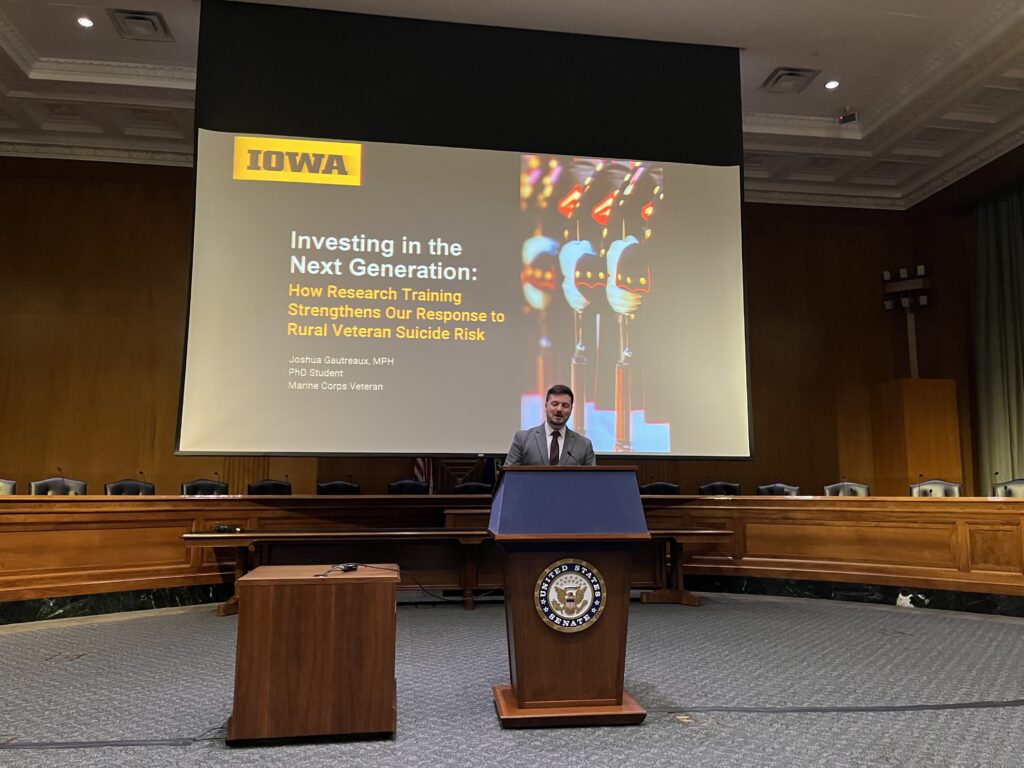
He spoke about his dissertation research in March 2026, when he joined the UI IPRC and other CDC-funded Injury Control Research Centers for a congressional briefing in Washington D.C. This event highlighted the importance of mental health and injury prevention research.
“I think that the higher we get in academia, the less represented veterans are,” Gautreaux said. “I’m speaking for and representing a lot of my brothers and sisters who don’t have this opportunity.”
Protecting veterans, he said, has long been a bi-partisan issue, with sustained attention and resources dedicated to address it. Despite this, he noted, the U.S. loses between 17 and 22 veterans every day – over 6,000 a year. He hopes his research will help improve support for veterans.
A heightened suicide risk after leaving military service
Although veterans receive college education benefits, Gautreaux said, some are unable to pursue higher education due to responsibilities at home. Many veterans come from underserved or underrepresented communities, he said, including isolated rural communities that lack access to healthcare and other services.
“Isolation is terrible for mental health,” Gautreax said. “Then you add someone’s veteran experiences, their potential combat experiences, and stress, while they are just trying to survive in this new world. It’s not surprising that the risk of suicide increases during that first year.”
Losing the structure of miliary life, where daily schedules are set and basic needs like food, housing, and healthcare are provided, can also be a challenge for some veterans, he said.
When he joined the miliary, Gautreaux said underwent a full year of Marine Corps training to prepare for a role that would span many years – followed by only a few days of preparation for returning to civilian life.
“That’s one year turning me into what they needed me to be to exist as a contributing part of this organization. And then three days to prepare me for the civilian world. There’s a switch that gets flipped when you join the military. But when you get out, it’s not as easy to switch it back.”
Finding a platform at UI
Gautreaux said he chose the University of Iowa for his doctoral program because there were faculty who supported his research interests and goals, including his advisor, Carri Casteel, and Tom Peters, both professors in the Department of Occupational and Environmental Health. Casteel also directs the Injury Prevention Research Center (an ICRC).
During the ICRC congressional briefing, Gautreaux emphasized the importance of training veteran researchers.
“There is this underlying feeling that ‘We see you, we understand what you want to do, and we support you in whatever you need,’” he said. “Being to be able to convey to individuals in D.C. that if not for this ICRC program, if not for this opportunity, these conversations wouldn’t be happening.”
If you are in crisis, please call or text the 988 Suicide and Crisis Lifeline at 988 or contact the Crisis Text Line by texting TALK to 741741. More information on suicide prevention efforts and resources can be found at Your Life Iowa http://www.yourlifeiowa.org.
Other resources
- Your Life Iowa
- Mental Health & Emotional Safety
- Preventing injuries & violence among U.S. veterans (UI IPRC blog post)
- Suicide Prevention (UI IPRC Research and Practice Action Team)